Featured Artists
Timothy Achor-Hoch
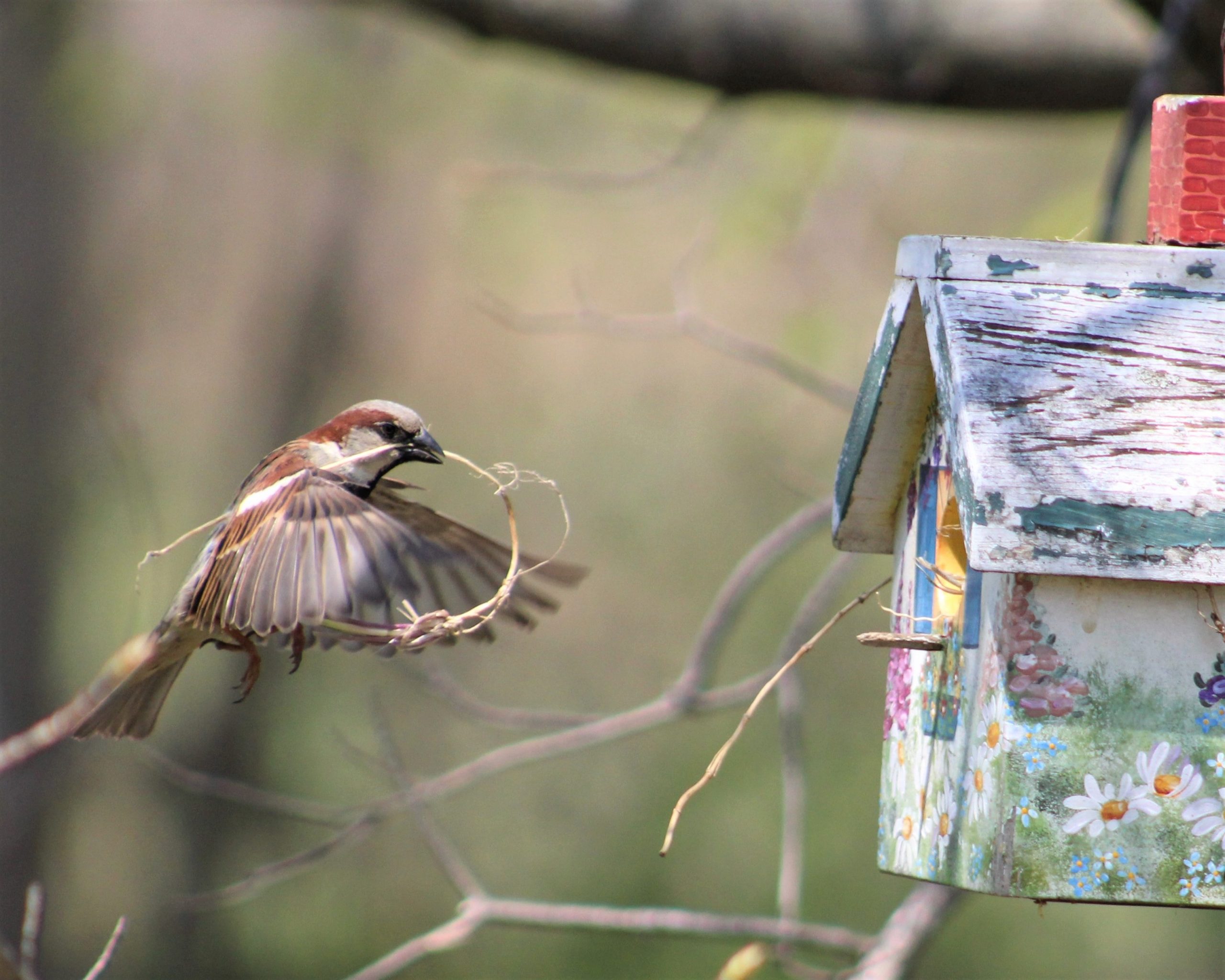
 From the cocky eastern bluebird perched on a branch to the sun-drenched gold of the Canada warbler to the cedar waxwing calling from atop a cattail, Timothy Achor-Hoch’s paintings evoke the unique spirits of birds. The artist — based out of his Fish Crow Studio in his West Pawlet, Vermont, home — works from both his own photographs and field experiences.
“I love painting birds because I see incredible beauty in their design,” he says. “What we see now is the result of millions of years of evolution. Their color and form are even more precious given the survival challenges they face.”
After pursuing art in high school, Achor-Hoch attended the Art Institute of Pittsburgh. He worked in an ad agency for a couple of years, then returned to school to study liberal arts at Juniata College in central Pennsylvania. There, a friend who was studying ornithology introduced him to birding, an activity that continues to drive his art. “We are at a crossroads with birds,” he explains. As much as he’d like to deny it, he says, “My culture is rapidly destroying their habitat, while simultaneously discovering ways to preserve it.” He aims “to raise awareness of a responsible way to interact with the natural world and at least do no harm. “
Achor-Hoch enjoys all the stages involved in painting birds, including being outside a lot with his camera. “I’m getting to know some nearby birding habitat in a way that I would never have imagined.” He also enjoys editing his photographs as he prepares them to inspire new compositions, using the imaging tools he learned from his earlier career as an art director.
The most challenging part of the process is the final rendering of his paintings on cradled birch panels. And the acrylics he uses pose their own problems, mostly because the paint dries much darker than it goes on. “Anticipating the color changes is an endless challenge,” he says.
While Achor-Hoch regularly manipulates a composition’s elements, his guiding principle is to evoke not just the bird, but also a piece of its environment as faithfully as possible. He is a studio artist rather than a plein-air painter, he explains, mostly because of his obsession with creating as accurate a representation as he can manage.
“I think my paintings come to life in the last stages, when the hue, value, and saturation of the color comes together with very specific detail of how light behaves on the subject and background,” he adds. “I like the idea of painting a specific bird, one that has shared a few brief moments with me. Sometimes the meeting is incredibly brief, and at other times, I have had a prolonged visit with an individual bird.”
Achor-Hoch also enjoys painting landscapes, most recently a pair of skyscapes. “In a way, it’s the same subject as the birds, in the same fields and woods,” he says.
In his spare time, Achor-Hoch enjoys playing the recorder, including Renaissance and Baroque music with a group of friends.
www.FishCrowStudio.com

New Member Gena Semenov
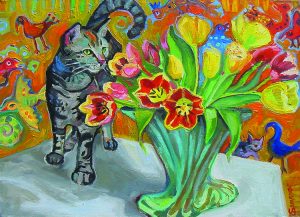 Walking into Valley Artisans Market, you can’t miss the vibrant tones and textures of Gena Semenov’s oil paintings. Her bold, colorful interpretations of animals and nature exude joy.Whimsy also often finds its way into her paintings, such as a small dachshund peering out of a high-heeled pump and a Boston Terrier chomping on a slipper. A tuxedo cat appears mesmerized by a goldfish swimming around in a small tabletop bowl, while an inky black shorthair sniffs a vase of bright purple tulips. No matter the animal, Gena expertly captures its spirit through color and texture.
Then there is her portrait of Bigfoot, a hulking deep blue and purple fantasy with a bemused expression.Her favorite subjects also include landscapes, still life, and portraiture.
Growing up in rural central Massachusetts outside the town of Winchendon, Gena was an only child whose mother encouraged her to draw pictures when she was bored.Her schoolteachers also gave her much positive reinforcement to pursue art. She went on to graduate from the Ringling College of Art and Design in Sarasota, FL and also studied under the French fauvist painter, Marco Bronzini.
In the 1980s and 1990s, Gena applied her graphic design skills to work in advertising and for corporations for a couple decades. She also taught art at a Montessori school in Florida for eight years.
Recently she moved to upstate New York to be closer to family and fell in love with Cambridge. She established her home with a studio there and is a new member of Valley Artisans Market.
When she taught art to young students, Gena says, she had the chance to dabble in papier mâché, gelli printmaking, graphic design, and digital art. But oil painting remains her first love. She enjoys the way it “helps you go into a zone where you lose yourself and the worries of the moment while you’re painting.” She approaches the creative process flexibly. The vision I have in my mind is always different from the final product, which takes on a life of its own,” she says. “I’ve had to learn to go with the flow of it. I guess it’s like a writer whose characters come alive in the writing process. The writer finds that they have to change the direction of the story because the characters demand it.”
Gena’s current goal is to spend more time painting landscapes. “I’d like to try my hand at plein-air painting,” she says. She’ll also continue experimenting with gelli prints. “I hope to make some cool prints that are more cohesive with my artwork genre.”

A peek inside – part two
What inspires the artists of Valley Artisans Market and where do they find the raw materials to create unique works of art? The answers are as diverse as the artists’ mediums, which include painting, photography, ceramics, fabric and felt art, wood, wood carving, stained glass, mosaics, cardmaking, pysanky, needlepoint embroidery, jewelry, basketry, and weaving.
Martha Starke of Saratoga Springs, NY is inspired by her extensive garden of flowers and herbs, which she picks and dries to design her whimsical note cards. What’s terribly challenging, she says, is hot summers like last year. “The humidity means I can’t press flowers because that extra moisture will turn them brown in the presses.” She needs dry, cool days for optimal pressing, but these have been rare in the last couple of years. Every year, she tries to introduce new botanicals into her creations, looking for fresh colors and shapes. She was excited to find a new flower, abutilon (flowering maple), that was blooming steadily in her garden with a rich coral color. But all of the specimens she pressed turned brown. She explains that some flowers, such as yellow ones, don’t reliably hold their color; Botanicals that are red tend to turn darker when pressed, while blue and purple ones are the most reliable. This unsuccessful attempt did goad her to search for new plants to add to her garden. She’s been known to come home with a carload of new plants, which, she reminds her husband, are tax-deductible.
Martha prizes good old-fashioned pansies. “They can be tricky to work with because gluing them down is akin to working with Saran Wrap.” Other favorites are Verbena because it always presses well and keeps its color, while Queen Anne’s Lace is easy to work with and offers many options for use, she says. And herbs press well and can offer many uses, including representing hair or limbs. “Plus, I can cook with them!”
Bliss McIntosh of Cambridge, NY has long sourced the black ash for her baskets from local swampy woods. “Last summer the only ones I could find were already dead from the emerald ash borer,” she recounts. This may mean that it won’t be possible for her to make baskets after she depletes her current supply of ash. She does, however, sometimes use the inner bark of elm or hickory. She uses white ash and occasionally hickory to split, carve and bend for the rims and handles of her baskets.
Her birch supply comes from various places, including from a forester friend in New Hampshire who has helped her source good bark from trees he is marking for harvest. Usually, it must be taken during a month-long window between mid-June and mid-July. She harvests spruce roots from places where spruce trees grow very closely together, like on a plantation of spruce.
Bliss collects corn husks for her hand-fashioned dolls after a hard frost. “My favorites are from popcorn as they are thinner and more flexible,” she says “I save the dried corn silk at the same time to use for hair.” She makes the “horns” from a gall that develops around a fly larva on the stems of goldenrod, and the milkweed pods must be harvested after the pods have opened and scattered their fluff.
Jean Clark, a painter, buys most of her supplies online. She uses a print supply store called Renaissance for her plexiglass, printing mediums, and beautiful papers. She buys her Holbein watercolor tubes from Blick.
Mary Lou Strode, also a painter, was captivated so much by a bird’s nest she found that she sewed it to her painting of the world titled, “Home Sweet Home.”
Carolyn Kibbe, a painter, generally paints from photographs, and takes most of the photos herself then prints them on regular paper. She sources most canvas rolls, stretcher strips, paints, brushes, odorless thinner, and equipment like easels and stretching tools from Jerrysartarama. Jerry’s carries most all paint brands. Ace Hardware in Cambridge has all the hanging materials. She also buys paints online from Blue Ridge. Locally, she finds Soave Faire, in Saratoga Springs, excellent for pre-stretched canvases, small items of framing hardware, spray varnish, and an occasional frame. “I always check out [VAM member] Chris Levy’s Green Arts website, too!”
Lise Winne paints from photographs and her imagination to make fantasy art, or work that has some meaning or symbolic message. She sometimes uses the computer to play around with a drawing for a design. Or she’ll use it for a whole work of art with an original drawing scanned in and colorized in the computer (only good for prints and cards unless she is doing one print without any duplicates that she can then call an original).
Her bouquet series (cards that use images of real flowers and leaves) is a combination of photoshop plus photographs. “I wipe out the background,” she explains, “so that I primarily end up with white behind each bouquet. I usually put an obnoxiously bright pink behind each bouquet to start as it is an opposite color and easier to see for the ‘wipe out” process’. Each bouquet takes a week or two of full-time work to finish.
Lise gets her painting supplies from Dick Blick and Soave Faire. She also likes Michael’s twice-yearly sales. Michael’s sells archival glass which is what she always uses for her works on paper, especially anything with watercolors or ink, to prevent fading.
Textile artist Kris Moss finds interesting items everywhere: “About the house, outside the house, and on our trips to 49 states and nearly all of the Canadian provinces,” she says. “Generally, these things are sticks and stones and shells, but not limited to such. Then there are photos in my head of all the places I have seen. I have even been blessed with gifts from others: a neighbor whose illness prevented her from utilizing her stash, parents of a young lady whose glaucoma was preventing her from continuing her needlepoint, scrapes from quilting friends, sticks and burls from my brother who creates gorgeous Adirondack furniture and one of my newest joys…the leftover warp threads from a weaving friend. Then, of course, I have grown fond of bead embroidery, basketry, and weaving… It seems I started just sewing but now I see ‘things’ in my fabrics that want to play with everything else I have collected and most likely I have become mixed media!”
Some VAM artists have formal art training while others are completely self taught. And some makers joined VAM decades ago as novices and have grown into their art. Would you like to join our family of makers? Please see our website for an application. Or come in any time to shop or browse. We love to talk about our art!

A peek inside – part one
Valley Artisans Market houses a rich variety of artists whose mediums and techniques vary as much as their work. The expansive range of art is made by hand using everything from foraged materials to utilizing technology to expand their creations.
Mark Madden, who makes woodcarvings and photographs of owls, finds something “mystical and magical” about the raptors. “They are quite common,” he says, “and they’re often heard at night but rarely seen.” To photograph owls, he faces the technical challenges of snapping night shots. “Some of my best photos are taken in almost complete darkness, with an exposure of a few seconds,” he says. Mark finds that photographing owls is a good way to study them in the field which helps him improve his woodcarvings. He travels all over New England and parts of New York State in search of his subjects. Last year, he traveled to northern Maine to capture pictures of a Northern Hawk Owl; last winter he visited Canada, where he saw several Short-Eared Owls and Barred Owls.
Stephanie Morton, who dyes linen and cotton gauze fabrics in stunning shades of indigo, buys her fabrics online from a California company that imports from Ukraine and Lithuania. She sources powdered indigo and dye supplies from a farm in Tennessee. She hopes to grow her own dye plants next year on her Coila, NY property.
For decades, Susannah White was a shepherd and cared for the sheep who supplied the wool she used to make her felted creations. Now she lives in the village of Cambridge and acquires her wool from friends who are shepherds. “I always try to use local wool and to make sure that the sheep have long lives and live on pasture,” Susannah says. She uses mostly local plants for dyeing, growing most, including sulfurous cosmos. “You can play with the pH and get a really brilliant orange,” she says. She also harvests some from the wild, such as the “beautiful yellow goldenrod.” She also purchases powdered indigo, madder and brazilwood.

Chris Levy only has to make a short drive to Greenwich, NY to Better Bee to find beeswax for her batik processes, such as in her Ukrainian eggs (pysanky) and her art pottery. “I’ve yet to find a human-made material that has the unique characteristics of beeswax,” she says. “It protects my ceramic glaze undercoats up to 1850 degrees Fahrenheit and allows me to multilayer glazes resulting in brightly colored and intricate designs.”
Tomi Bentley, a weaver, buys her threads and lining fabric online. “It took me a long time to figure out which threads were suitable for what I wanted to make,” she says. She mainly uses Swedish cotton thread, linen thread, Dutch cotton thread, Canadian cotton thread, and a Japanese silk thread. Because the color is not always certain online, she relies on color samples to make her choices. She has learned to be patient – sometimes it takes several weeks to get the thread.
Debra Salat, a needlepoint embroiderer, used to buy her fabrics brand new, but now she frequents thrift stores for men’s shirts and other more luxurious finds, including a beautiful piece of doeskin and red velvet curtains. She still buys embroidery thread occasionally but enjoys the largesse of friends who gift it to her. “It’s wonderful; I probably have 20 years of embroidery floss,” she says.
Diana Schleicher sources most of the glass for her stained-glass pieces from a local shop, Deluge Design in Cambridge, NY. She likes to use seashells, wood, and beads in her projects from a collection of shells and other objects she’s gathered over the years. Popular items are her bright orange glass feathers, adorned with small, colorful beads.
Nancy Roberts is always game to score a free roadside table or other small discarded wooden item in a thrift shop that can be repurposed as a mosaic work of art. She buys glass online and also boxes of glass scraps from Adirondack Stained Glass Work in Gloversville, NY.
Some VAM artists have formal art training while others are completely self taught. And some makers joined VAM decades ago as novices and have grown into their art. Would you like to join our family of makers? Please see our website for an application. Or come in any time to shop or browse. We love to talk about our art!

Mark Madden

Mark Madden has long viewed owls as “mystical and magical,” inspiring him to create compelling photographs and wood carvings. The new Valley Artisans Market artist finds the raptors’ charismatic expressions and calls to be an endless source of fascination. “Owls are associated with spirituality, wisdom, and omens in many cultures,” he notes, including Greece, where the owl symbolizes Athena, the goddess of wisdom.
Madden’s carvings are lifelike, painstakingly executed images that capture these birds in their full magnificence. He believes his carvings have benefited from his years of studying and photographing owls in the field. His photographs are available both as framed prints and smaller cards and feature many different varieties. One, a Red Screech Owl, peers out of its knothole against the full moon while a Snowy Owl perches on a rocky coastline by a lighthouse.
Madden travels all over New England and New York State in search of his subjects. Last year, he went to northern Maine to get pictures of a Northern Hawk Owl and last winter found him in Canada, where he saw several Short-eared Owls and Barred Owls. He’s also a regular at the Washington County, NY grasslands, where Short-eared Owls and Snowy Owls (in winter) abound.
“It’s an adventure taking pictures of owls,” Madden says. Often heard at night but rarely seen, they’re elusive because they don’t like to be around humans. “They are usually sleeping during the day, so you have to wait until evening for them to wake up and open their eyes.” The next challenge is getting them out of their nest hole. He eschews using calls because that can disturb and attract other owls that may be predators. Instead, he just waits patiently. Owls are most active late at night and in the early morning, giving him an hour’s window of good light. But sometimes he faces the technical challenge of nocturnal photography, which means multi-second exposures in nearly complete darkness.
Madden’s studio is in his home in Bennington, VT, with one room devoted entirely to woodcarving. “Then I take over the kitchen table to paint my birds,” he says. “It’s always a challenge to get a nice, soft look.” He uses an airbrush and light washes to slowly build up the colors.
With a graphic arts background, Madden worked in the printing industry for many years. He is largely self-taught, poring over books and also taking seminars from other carvers to learn different techniques. “The best thing, though, is studying the birds directly in the wild. Nothing is better than seeing the bird in its natural setting,” he says.
Accordingly, Madden asks that if you see owls in your area, contact him if you’re willing to let him come over and photograph them: obsessedwithowls@comcast.net.
– Nancy Roberts
Erin Sheridan
 Wherever Erin Sheridan goes, she keeps an eye out for the eclectic items that grace her cotton clothesline rope baskets. Peacock feathers, felted flowers, vintage jewelry, geodes, and even antlers adorn the unique vessels she creates in her Hummingbird’s Heart Studio located in White Creek just outside Cambridge, NY.
Erin’s background is equally eclectic. A college English and Journalism major, she joined the Air Force and worked as a Crew Chief on B-52 bombers in the late 1970s. Eventually, in 1989, she became a real estate agent and broker, also working as a NY State certified real estate licensing instructor and continuing education creator.
But she was always drawn to artistic pursuits. Her mother, a musician and accomplished chef, opened a restaurant and bar in the area in 1969 and there taught Erin culinary skills, including baking and cake decorating. This led Erin to establish her own catering business for a time. Her mother also taught her to sew, a lifelong passion.
“I love the sewing process,” Erin says. “Once I start to build my basket, the repetitive motion is very calming to me. None of the baskets are ever the same—they start to take on their own shape and personality as I work on them.” She sometimes uses her commercial embroidery machine to create the bases for the baskets. She enjoys digitizing some of her original designs for her machine to “read.” Current examples include a loaf of bread (for a breadbasket, of course) and a tree of life. It was worth it, she says, to travel to Chicago twice to learn how to use the required software.
Erin’s passion is to make her baskets functional, as well as ”pieces of art that everyone will enjoy.” She especially loves using unique elements from nature and incorporating them into the exterior of the basket. “Sometimes the decoration is the very first component. If I find an interesting piece of bark or a cluster of unusual moss or feathers, it will inspire my basket’s design.” A challenge she faces is finding the right quality rope, because most rope these days is made of plastic or other synthetics. Another challenge, she says, laughing, “is not breaking 20 needles on one basket.”
Erin has always been a “maker of some sort,” as she puts it. While working at a quilt shop in Saratoga she taught classes in quilting techniques, design and color theory. Over the years, she has also taken classes with different artists in a diverse variety of mediums, including quilting, weaving, fabric dyeing, and printing. She enjoys making paper beads and jewelry from junk mail and creates art quilts using her hand-dyed fabrics and felted wool. Many of her artistic creations have always involved sewing of some sort, but baskets were a “What if!” moment for her. She says, “My attitude has always been, you can’t fail unless you try. Although I’ve failed miserably at some things, I’ve mostly enjoyed much success at others, and doesn’t that make it all worthwhile?”
– Nancy Roberts
Featured artist: Jean Clark
Jean Clark’s environmental portraits of animals are engagingly intuitive. A goat munching dandelions peers placidly at the viewer in a colorful monoprint, while in another, a great ape savors a ripe banana. The coy gaze of a hippo by a riverbank seems nearly human, while a squirrel ‘s delight at a trove of acorns is almost palpable.
Then there is the small black dog with foxy ears, a frequent figure in Clark’s work. Whether shown exploring the wider world or homeward bound, Clark’s depiction of the little canine nails the specie’s characteristic curiosity—and loyalty. “We’ve always had dogs,” she explains their lure as subject matter. “I simply observe them at home.” In fact, her 12-year-old rescued black Labrador retriever, Tucker, is her occasional muse.
Viewers have often remarked on the whimsy and sense of wonder in Clark’s work. Joy is implicit.
Another frequent subject in Clark’s art is houses. In bright, warm colors, she captures their allure as a place of respite, of home. In “Reflections,” she shows how their images ripple into the peaceful void of a lake. “Houses are my portraiture,” Clark explains.
Another favorite subject is weather’s many moods, as in the monoprint “Stormy,” which captures the swirling drama of thunderstorm clouds.
Clark grew up in the suburbs of Westchester NY, one of eight girls and five boys. She recalls “being serious about art” from an early age. There in the Greater New York area, she remembers that “my inspiration was graffiti. I lived on a small island in the Bronx and loved the daily commute into the city, with pop art by Keith Haring all over the sidewalks and on the subway walls. It got me excited about fine art and the Neo-Expressionism movement that was emerging in the late 1970s and into the ‘80s.”
In high school, she studied commercial art and a teacher’s mentoring led her to get a scholarship right after graduation to the Art Students League. Subsequently she enjoyed a career designing stained glass reproductions for museum gift shops and the gift trade.
After years of downstate life, she and her husband relocated about thirty years ago to the outskirts of Greenwich, NY, where she finds the rural lifestyle congenial to her creativity. Long a perennial gardener, she’s nurtured Lenten roses (Hellebores), yellow irises, and the tree -climbing hydrangea. Perhaps not surprisingly, flowers occasionally show up in her art, such as a lush bouquet of blush roses in a blue checked vase.
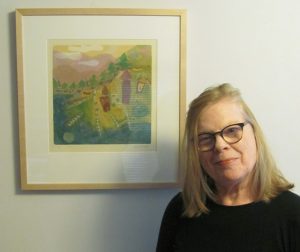 Clark’s work has been exhibited in many local venues, among them the Saratoga Arts Center, the Troy Arts Center, Lake George Arts Project and the Agricultural Stewardship Association’s “Landscapes for Landsake” show. An important influence has been taking printmaking classes with Sunghee Park, an instructor at the Troy Arts Center. “She was so inspirational,” Clark says. “Having such a wonderful teacher just drew me to printmaking. I found that it’s an exciting process with a whole series of steps involved that I immediately took to. I really do enjoy the whole process of printmaking, step by step.”
Welcome New Member, Susannah White
Felting is the oldest known manipulation of the natural world. It is older than stone work, basketry or claywork. That is because wool doesn’t require human intervention to felt; the wool of a sheep’s coat, for instance, is naturally felted.
Susannah White theorizes that early humans recognized this quality and were immediately drawn to felt’s versatility.
The natural process of turning frayed fibers into a solid piece of fabric is only a short leap to stunning artwork. Susannah herself has mastered that process.
Susannah began working with fibers more than five decades ago. “Our family had a farm where we spent most of time when not in school. Our neighbors were sheep farmers and I started playing with their wool back in the 1960s.” Because she loved everything textile, she discovered felting on her own. When she saw a museum exhibit featuring felted wool from an ancient tomb in China, her life’s calling was realized. As a young felter, she absorbed everything she could about the process.
Susannah describes felting as a physical change in fiber. “Any protein has scales along the fiber. You aggravate the fiber with hot water and [then add] something annoying to the fiber – like soap – which causes the scales to open up. You use your hands by massaging, rubbing, and pounding the fiber, which makes the scales lock on to one another. Once in cold water, everything contracts and locks and makes a permanent change in the fiber,” she explains.
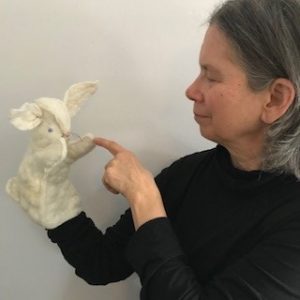
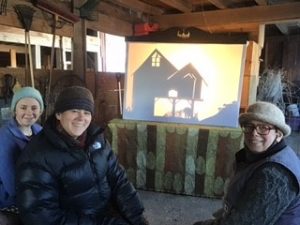
For Susannah, felting came by way of weaving (starting with her first loom at age 13) and textile design in college. With the birth of her children, however, Susannah didn’t have the luxury of time to warp a loom. She returned to felting by fashioning felted toys for her kids. “I believe strongly that children should have the most carefully made objects in their life,” she maintains, “and the objects most thoughtfully done should be for children.” “When I was young, my dad traveled all over the world and would bring back puppets. He built a puppet theater. There was one thing that frustrated me: he gave me Steiff hand puppets. They are fun to work with but when you removed your hand, all the life left them like a deflated balloon. I was always sure to make puppets so they retained some life force. I wanted my puppets to have a lively aspect whether or not they are in use,” she says.
To be sure, her passion for shepherding, feltmaking, quality craftmanship, and puppet artistry all intersected in her unique work.
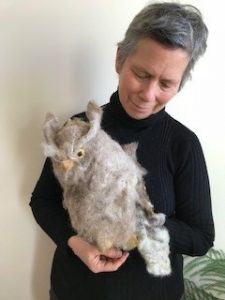 Susannah’s puppets and performing objects are made from the wool of family or friends’ sheep. The vibrant colors, she says, come either from plants or from the natural color of the wool. “Because I work in textile design, I am aware of the carcinogenic and mutagenic qualities of commercial dyes. Plant dyes are relatively harmless, depending on the mordant used. I only use alum and cream of tartar. The colors are very beautiful— they can be very intense or very subtle — and have a distinctive living quality to them. They complement one another. Each year I grow or wild harvest more of the plants I need for color,” she says. Indeed, at this point, Susannah only purchases three plants for dyes: indigo, brazil wood and madder. And this year, experiments with growing indigo began in the Cambridge Community Garden. “We successfully grew and harvested fresh indigo and dyed both wool and silk, though only in small amounts. We’ll see if we can increase the amount of color we get next year.”
“If you are looking at old rugs or tapestries and see that beautiful rose/salmon color,” she says, “that’s madder.” (One time she accidentally fermented some madder. Not wanting to waste it, she threw some wool into the dye and was delighted to get a brilliant red from it!) It is the capricious unpredictability that makes dyeing with plants so fascinating and lively for her.
Currently, she is most delighted by making sweet and simple mouse and chicken finger puppets and never tires of these characters. “Part of being a craftsman is that you spend your life developing your skill and then you spend whatever remains of your life just doing it. It is not my goal to make anything different. My goal is to make everything well. I’m at the phase in my life when I know what I am doing,” she says. But even after 40 years of working with felt, she has still taught herself more. She has recently learned that the tighter a puppet is on one’s hand, the more control one has.
Susannah is not just the artist behind the scenes. Three generations of her family, collectively known as Dancing Hands, give performances to audiences for free, though COVID has postponed most performances over the past 20 months. She takes pride in trying to preserve a heritage craft.
In summing up her craft she says, “There’s that saying that one person can’t change the world. But one person can make felt, which is a permanent change.”
Welcome New Member, Elizabeth Roberts
 Viewing and creating art has intrigued Elizabeth Roberts since her earliest days. She recalls being fascinated as a kindergartener by the paintings her artist mother took her to see at the Munson-Williams-Proctor Art Institute in Utica, NY. A special treat was lingering in the museum’s store, where she would use her allowance to buy the polished agates that looked like miniature landscapes to her.
Later on, she says, “I doodled my way through grade school and high school.” Her specialty was secretly creating ballpoint pen caricatures of classmates and teachers that even included moving parts, such as a cardboard insert that could be shifted back and forth to suggest darting eyes.
While majoring in psychology at the State University of New York at Oswego, she also took a few studio arts classes “because they sounded interesting.” After college, she signed up for a course in painting at Syracuse University where she created a work she says she’ll never forget: The Egg Painting. The instructor assigned the students to paint a still life consisting of six eggs sitting on an old dark wooden table. Elizabeth dutifully used her palette knife to mix up what she thought were “eggy colors,” of cool and warmer grays. “I didn’t know how to blend colors yet, nor to look in a mirror to check if the perspective was skewed,” she says. Nor had she learned yet how to use a paintbrush, so she simply mushed the oil paints in with her palette knife. The result was a scene of “ugly little eggs drowning on a huge table that leaned to one side, with a solid background of cream-colored paint with no gradation whatsoever.”
She laughs, recalling how she wanted to destroy the painting. But her father, a teacher, suggested that it was so awful that she should keep it to remind herself and show others that improvement is possible.
Some 40 years later, Elizabeth has kept this, her very first painting, for just this reason. “It taught me that you can drown in oil paints if you don’t keep control of them,” she says. She went on to earn a master’s degree in painting at the State University of New York at Albany. “That’s where I really learned to paint,” she says. “All of the classes helped me to learn not only from my own mistakes and successes, but from everyone else’s.”
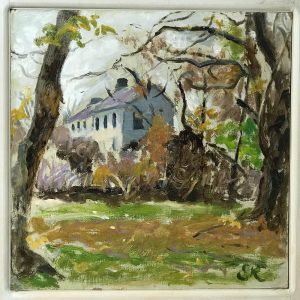
Over the years, between working with those with developmental disabilities and, until she recently retired, caring for the elderly, Elizabeth has continued to paint in oils, pastels, and acrylics. She’s particularly drawn to the rolling rural landscapes of Washington County and its venerable vernacular buildings. But she also likes to paint portraits and fantasy landscapes. She has exhibited her work in various locales in her native central New York State, including the Munson-Williams-Proctor sidewalk art shows, the State University of New York at Morrisville library, and in a Minneapolis gallery. One memorable exhibition was a joint effort with her late mother, Doris Pellettier Roberts, a watercolorist, at the Morrisville library. “I learned so much from Mom,” Elizabeth says. “She was my most constructive critic.”
She is grateful for all of the trips to art museums that her mother provided. “A good museum gives you an idea of the possibilities,” she says. “Mom would walk with me as I looked at all the paintings, like Thomas Cole’s “Voyage of Life” series, which I loved as a kid. You could get lost in the landscapes, in another world, a beautiful fantasy.” Another early favorite was William Harnett, whose 19th-century trompe-l’oeil still lifes of everyday objects looked so realistic that “you could reach out and touch them, with amazing highlights that he piled on.”
Another childhood influence was the public library, to which her mother often took her. There Elizabeth reveled in the art books, which introduced her to innumerable artists and styles. “I’m still reading books on art constantly,” she says. “If I get any more, my studio (in Saratoga Springs) will collapse from the weight.” A longtime favorite is George Inness, whom she describes as “not just a landscape artist, but a visionary.” She is drawn to “the mystery in his paintings; they hold you captive with their dreamy quality. The colors are beautiful and perhaps the places are recognizable, but transmuted into being a state of mind, or awareness of God, a spiritual feeling. Everything isn’t spelled out; you get caught up in his landscapes.”
She finds inspiration in “a play of light and color that I might see, classical music [Rachmaninoff is a favorite], my internal emotional state, words or ideas that suggest feelings or visual metaphors, and even a random set of marks that can suggest a scene or figure.” A random mark could be something as simple as a pattern in the kitchen linoleum, she notes, pointing to DaVinci’s suggestion of finding inspiration “in random things around you,” such as the patterns in peeling paint.
To jumpstart inspiration, Elizabeth finds that “a bit of extra energy kickstarts being creative, so I prescribe coffee for myself and off I go.”
For her, the most enjoyable aspect of creating art “is experiencing the state of flow where one isn’t really directing oneself so much as forgetting about oneself and letting the work take you where it will. It’s almost as if someone else made the work and I get to be surprised at the end when I wake up from the trance and see what I’ve created. It’s fun to surprise yourself and create something you didn’t think you had it in yourself to do.”
She adds, “I love doing art because it can be all things; it’s a means of communication that has the scope to encompass and distill anything in the world and hopefully be beautiful and meaningful in the process.”
This is an artist who likes to make “anything and everything, from painting portraits and landscapes to making finger puppets and tiny, illuminated cardboard houses.” As she explains, “It’s hard for me to stay in the box. I like to mix things up and try new things.” Always experimenting, she recently started making prints with gelatin plates. She also paints little scenes and affixes them to the bottom of a piece of plexiglass and then paints another layer over the top. “It’s painting on two different planes,” she explains, “and it gives a three-dimensional effect.”
Her biggest challenge is “my own perfectionism, which is not fun to experience but on the other hand, it drives me to constantly try to surprise and surpass myself in everything I do. I just want to keep getting better. And also spread the joy of creating art to viewers.”
Welcome new member Kristina Martin
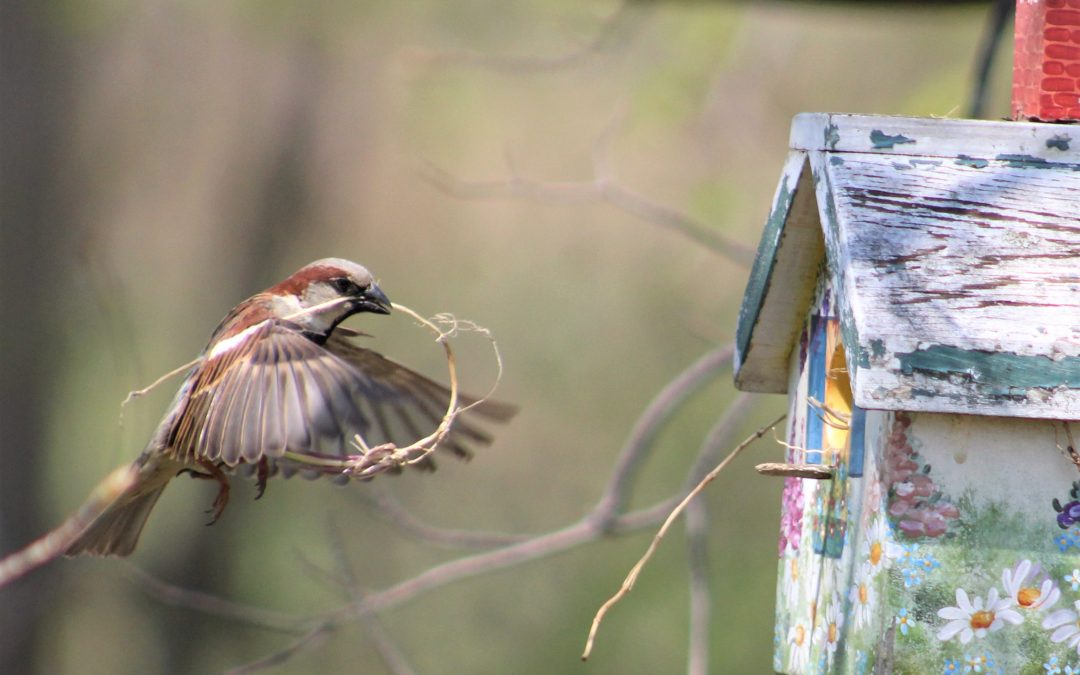
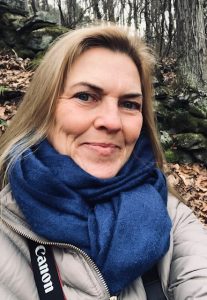 Empty branches may be beautiful but for Kristina Martin they are a photo failure. It’s the birds that have just vacated the branches that she is hoping to photograph. “I take a lot of photos to get to the good one,” she says.
Her interest in birding started in 2016, after a 30-year career as a medical transcriptionist. Lured by the songs and chirps, flights and feathers of birds, she picked up a camera in order to capture their images to identify these fast-moving creatures and study them more closely. As she began photographing them, she discovered their quirky secrets: the catbird loves to splash and bathe; the wings whistle when the dove takes flight.
“I ended up with all these photos. So I made cards for family and friends. They said they were pretty good! I put together a basket and put them on the counter at Yushak’s (general store in Shushan, NY) and that’s where it all started,” she says.
Kristina loves nature and being outdoors; she doesn’t mind how challenging photographing wildlife can be. Recalling a recent evening in Fort Edward, I can hear a smile in her voice. She hunkered down in the tall grass and waited for short-eared owls that have migrated locally from the arctic to appear. Owls are a favorite subject of hers to shoot partially because they are nocturnal; it’s difficult to get a good shot in natural light. “They came out at dusk and were flying over the grasslands,” she says.
Her work has grown into an extensive line of cards but she also offers enlarged prints and framed art. As customers have requested, she has expanded her work into nature scenes and rural living, including florals, barnyard scenes and covered bridges. (She had a fox family in a hedgerow behind her house last year. She set up a blind and was able to watch four kits grow up while getting great photos for her cards.) She plans to package her cards into gift sets and will create groupings of birds, flowers and more for Mother’s Day and springtime.
Her art is transforming as she gets more practice. She introduced photos that are more abstract. “It’s fun to see people’s reaction to my more abstract work. Some people really get it,” she says. For instance, she took a photo of a snow bend with trees and altered it into sepia. There’s a path that’s lighter than the surrounding area. “It’s nature but it’s funky,” she says.
Although Kristina tries to keep photos as genuine as possible, she uses digital technology, specifically Lightroom, a photography platform, to facilitate the finest result. “I try to make sure the photos I take are the best they can be to start, depending on the conditions. Editing or enhancing photos is part of the craft, improving on the original photo, creating more definition by cropping or enhancement,” she says.
Kristina is enjoying being a relative novice, always learning something new. She appreciates the feedback she receives from her customers as well as tips from other photographers.
Kristina is happy to accommodate specific bird photo requests. She also offers enlargements of any images seen on her Whistle Wing Print cards. “Creating hand-crafted cards and prints allows me to share the beauty, charm and humor I see around me every day.” In the meantime, Kristina will keep on getting outside and shooting … hopefully not another empty branch.